Monday, 11 January 2016

Film - Star Wars: The Force Awakens (2015)

You were the chosen one! (Warning - Jumbo Review; possible mild spoilers)


It's about thirty years since the deaths of Palpatine and Vader and the defeat of the Empire at Endor. In the intervening time, the First Order has risen from the Empire's ashes under Supreme Leader Snoke and, with the New Republic unwilling to plunge the galaxy into war again, Leia Organa breaks away to form a small, plucky Resistance to fight back. Their best pilot, Poe Dameron (Oscar Isaac, Ex Machina), is on desert world Jakku, searching for a star map that will lead the Resistance to the almost-mythical Luke Skywalker (Mark Hamill), who has gone into seclusion after his attempts to rebuild the Jedi Order ended in tragedy. When Poe is captured by Kylo Ren (Adam Driver, Girls) and the First Order, his droid BB-8 escapes with the map, encountering young scavenger and mechanic Rey (Daisy Ridley), while Poe himself is rescued by defecting Stormtrooper FN-2187 (John Boyega, Attack the Block, which is very good by the way), renamed Finn. After escaping the agents of the First Order with the help of Han Solo (Harrison Ford) and first-mate Chewbacca (Peter Mayhew), Finn and Rey find themselves enlisted on a secret and desperate mission to return BB-8 and his map to the Resistance, allowing Skywalker to be found and hope to be restored to the galaxy.

There was nothing truly wrong with the conception or journey of any of the characters in the prequels, but they frequently and reliably fell down in the execution, with very few of the actors - Ewan McGregor and Ian McDiarmid being the wonderful exceptions - able to rise above the stilted and awkward material they were given by Lucas in both his dialogue and his direction, often forced by the inadequate screenwriting to describe or explain their feelings rather than demonstrate them. Furthermore, with every named character being a senior politician, a warrior monk or an evil sorcerer, the trilogy had no relatable everyman for the audience to latch on to. With the combined forces of writer Lawrence Kasdan (The Empire Strikes Back) and director J.J. Abrams (Super 8, Star Trek), the characters finally feel like real people, able to act and speak and develop in a way that feels natural to them, rather than simply being railroaded into whatever destiny they need to meet for A New Hope to happen. Just about every character gets something interesting and, often, amusing to say - the cast being allowed to deliver their lines like normal humans rather than emotionless robots means The Force Awakens' comedy elicits grins rather than cringes. Although some characters are given little time in which to shine, the film handles them all deftly enough that we can be sure that those who do feel underdeveloped have much more still to reveal as the trilogy progresses.


Given the tall order of essentially carrying the film, little-known Brits Daisy Ridley and John Boyega excel wonderfully, giving more lively and nuanced performances than even the original trio of Luke, Leia and Han managed (perhaps a somewhat unfair comparison, given that Lucas was still writing the dialogue back then). Abrams and Kasdan use the old guard sparingly, re-introducing them one at a time, cleverly beginning with Ford's aged but still dashing rogue Solo - the most relatable of the original three by some distance. Leia (Carrie Fisher) returns some time later, bringing out a more tender, wounded but welcome side to the curmudgeonly Han. Luke is the least-seen of the original cast, appropriately: as the last of the Jedi and one of the most powerful characters in the now non-canon Expanded Universe, too much Luke might have crushed The Force Awakens under the myth that has accumulated about the character. Used exceptionally sparingly here while the film patiently sets up its new characters and conflicts, the real reintroduction of the Skywalker legacy is deferred to the next film, where it can be given the room it needs without burying the incipient trilogy under the weight of its own backstory.

"There are stories about what happened."
"It's non-canon. All of it."
The central character for the new trilogy would appear to be Rey, a young scavenger on the planet Jakku. Like Luke and Anakin before her, she grew up on a desert world, is an ace pilot even of vehicles she's never flown before, and likes to tinker with droids, ships and whatever valuable parts she can salvage by day from the wrecked Imperial and Rebel ships strewn throughout the sand dunes. By night, she sits outside her cosy abode (a toppled AT-AT), looking at the ships taking off from the distant spaceport and wearing a salvaged Rebel pilot's helmet: without a single word of dialogue, we know that she dreams of leaving Jakku and travelling the stars, but is settled in for the long haul. Her early lines to BB-8 after rescuing him from a junker establish that she's waiting for her family to come back for her, and although she jokingly tells him that her background is "[classified] too. Big secret", a part-vision part-flashback she receives later in the film suggests that she was left on Jakku for a reason and may be more connected to the Jedi and the Skywalkers than she knows, but more than this the film declines to tell us. What we do know is that Rey is brave, intelligent, quiet, and more than capable, with an idealistic view of the Resistance and the Rebellion, and a determination to stand against evil even if it terrifies her. Beyond these qualities, we know little, and certainly she does not appear as flawed and undergo as much of an arc as Finn (which has led to accusations that the character is a Mary Sue - accusations that were never levelled at Luke and Anakin, and so make me wonder exactly what it is that some find so unrealistic about a brave, wholesome, idealistic and skilled girl). It's clear that the film is playing Rey up as something of a mystery, and no doubt the series will uncover some dark and hidden depths beneath the enigmatic past as it continues. Daisy Ridley gives an absolutely winning performance, charming precisely because of its wide-eyed wonder and purity, and its infectious enthusiasm for adventure, as well as its steely determination in the face of the soulless onslaught of the First Order and the dark side scare tactics of Kylo Ren, and her burgeoning realisation of her own strength and purpose after previously believing herself to be "no-one" is a joy to behold.

The pairing that launched a thousand fanfics.
Finn is much more of a secondary protagonist than a supporting character, and the film gives him plenty of things to do without it seeming that he's just there as a helper for Rey. His own history as a Stormtrooper, though left mostly-offscreen, informs his every thought and deed, and he undergoes a similar arc to Han Solo in the original: mainly concerned with his own well-being, he rejects any kind of cause whatsoever, abandoning the First Order and then only going along with Rey on BB-8's mission to return the map to the Resistance only as far as it gives him a direct line away from his former masters. Unlike Solo, Finn's primary motivation isn't callous self-interest, but fear. He has seen firsthand the ruthlessness and military might of the First Order, and although he refuses to go along with their conquest and slaughter of innocents, he believes they are too powerful to be fought and simply wants to run away. When he first meets Rey, he leaps upon her false conclusion that he's with the Resistance - Boyega's confident but clueless bluffing and comic delivery here are superlative - and she becomes the only person to ever treat Finn as a person and not a number. Through his friendship with her and growing investment in her mission, Finn comes to understand - though the film happily never feels the need to have him say so - the worth in fighting and possibly dying for a cause greater than himself. Boyega shines in the part as a likable coward, bluffing and occasionally bumbling his way to safety whenever he can, but also has the determination and bravery to capture Finn's moments of action and heroism, and the acting chops to imbue his most honest scenes with sensitivity and vulnerability, and the character is so well-constructed that Finn's disparate qualities satisfyingly harmonise with each other rather than jarring.


Captain Solo's days of gundark ear-tearing are long past.
Surprisingly, I was a little less convinced by the return of everyone's favourite scruffy-looking nerf herder. Don't get me wrong: it warms the cockles of my heart to see Harrison Ford back on the Millennium Falcon, swinging his DL-44 around like a Western gunslinger back-to-back with Chewbacca and playing the new Obi-Wan, dispensing nuggets of sour wisdom to the idealistic youngsters who just don't know what the galaxy is really like. But there are a few spots in Ford's performance where it's clear the distance of time since Return of the Jedi has taken its toll, and it suddenly feels like I'm watching him in Crystal Skull rather than Empire Strikes Back, reprising the character because he feels like he has to, rather than wants to. However, these rust spots are outweighed by many more wonderful moments, mainly with Finn and Chewie, where the old Han shines through the crusty carbonite shell as though he'd never been away at all, including laugh-out-loud moments where he instructs Finn, in typically blunt fashion, about how the Force works (or doesn't), and when he insists to Chewie that, yes, he does always talk his way out of tight spots - every time. His long-deferred reunion with Leia is played perfectly by both actors, sharing the knowing familiarity and unspoken connection of the best and oldest of friends, but with a wounded edge of reserve and regret that the happy ending promised by Return of the Jedi couldn't be forever. By the end, he still feels like the same rogue flying by the seat of his pants as always, but there's an edge of weariness that lets us know that Han has lived a life, and suffered emotionally in a way that he would never have dreamed of by the end of the last trilogy.

Han Solo comforts Leia during one of her 'gold bikini' flashbacks.
Carrie Fisher, returning as Leia, is probably the least well-served of the original cast. Hamill's role is much smaller and he has far fewer lines, but there is a palpable sense that the film has been building up to him, and the mythical nature of the Skywalker name invests Hamill's appearance with a weighty and epic quality despite its brevity. Leia, on the other hand, doesn't really get to do anything that a new character or anyone else couldn't have done (aside from the references to her relationship with Han), and has become a bit of a Mon Mothma. However, there are some nice scenes that hint, although the Jedi life apparently wasn't for her, her connection to the Force is still strong and keenly felt, and it is wonderful to see her portrayed as a caring and maternal figure without the usual screenwriter's pitfall of it making it feminise or undermine her qualities as a successful leader and diplomat, and the presence of both her and Rey probably serve to make this the most progressive Star Wars film so far. It says a lot for the quality of the writing and the performing of these characters that an actor only just failing to 100% recapture a role they last played thirty years ago is the worst I can say about them, and a simple moment where Solo restates his old boast about the twelve-parsec Kessel Run while wistfully looking over the Falcon cockpit he hasn't seen for years gave me my second-biggest smile of the entire film. Although he has no (intelligible) lines, Peter Mayhew steps effortlessly back into the role as trusted first-mate Chewbacca, and it's worth repeated viewings just to notice his subtle, deprecating body language in the background of scenes, as he half-apologetically undermines his long-term partner's bluster and boasting. Although Chewie's wordless nature makes it difficult for him to rise above simply being Han Solo's tagalong, The Force Awakens finds much more for him to do than previous films, and he takes a leading role in many of the battle scenes, as we finally get to see the power of his Wookiee bowcaster in action.

Light years from Hoth, Poe is perplexed to find a
perfectly intact snowman.
The last of the 'good guys' is the Resistance's ace pilot Poe Dameron, who disappears for a long portion of the movie when he and Finn crash on Jakku in their liberated TIE fighter. Before this, he had appeared wisecracking and brave in the face of interrogation and Kylo Ren's intimidating mask, as all heroes should be, but also compassionate in his worry for the safety of the Jakku villagers trying to buy him time to flee in his X-Wing with the map to Luke. Unlike virtually all of the other characters I've seen Oscar Isaac play, there's virtually no darkness to Poe Dameron. He both looks and acts ruggedly, traditionally heroic, and though he's clearly an experienced combat veteran, he isn't cynical or jaded whatsoever, and when he demonstrates his piloting skills in coming to the rescue of Rey and friends later in the film, he whoops and hollers with exhilaration. It can't be said that - with his limited time here - there's a tremendous amount of personality to Poe Dameron, but having suffered years of anti-heroes and flawed heroes and the apparent belief that a protagonist can't be interesting unless they have some crippling personal neuroses, the steadfast, levelheaded, earnest goodness of Poe - and Finn and Rey as well, to be honest - is a breath of very welcome fresh air, and I look forward to seeing what Isaac will be able to do with the character with some expanded screentime in the following films. This also seems a good time to mention that Poe's droid, BB-8, is every bit a worthy successor to R2-D2 and C-3PO as the team's droid/multi-functional tech expert, as well as comic relief - especially a guffaw-inducing bit of physical comedy as Finn (who, unlike Rey, does not understand any alien or droid languages) tries to persuade BB-8 to give up the location of the Resistance base so he can convince the nearby Rey that he already knows it. As good as it is to see R2-D2 and C-3PO again when they turn up later - R2's entrance is dramatic, 3PO's is hilarious in taking the wind out of an emotional moment - with BB-8 on hand throughout I can't say I felt their absence too keenly.

Yup, it's an Abrams all right.
Kylo Ren, with his black faceless mask and dark cloak, appears at first to be a Darth Vader wannabe, although his impressive Force powers and rage-fuelled swings of his crossguard-equipped lightsaber (apparently required due to a flaw in its construction) mark him out as a dangerous and intimidating opponent, especially during his Force-assisted interrogation of Poe, in which he tries to drag the answers straight from Poe's mind. The deep voice modulation of the mask combined with Driver's intense-but-restrained delivery transforms a prosaic question like "Where is it?" into a moment of pants-wetting terror. For the most part, his power seems absolute and the rest of the First Order walk on eggshells when dealing with him - especially when reporting failure. During Ren's interrogation of Rey, he removes his mask in the timeless villain tradition of trying to appear more human in the hope this will somehow endear them to the hero, and we the viewers are greeted with the bouffant hair, crooked nose and red watery eyes of Adam Driver. The removal of Ren's mask is a considerable reduction of his menace, but unlike Anakin's petulant whining it feels entirely deliberate. Ren is still conflicted about his choice of the dark path; still feeling the pull of the light - he invokes the charred and melted helmet of Darth Vader for forgiveness and guidance. Indeed, it is revealed that - in a nice touch that works both within the film and on a meta level about it - Ren fears that he is not a worthy successor to the mythical status and achievements of Darth Vader, and is consciously emulating him. But where Anakin's immaturity damaged his credibility as a great hero turned terrifying instrument of evil (and sadly undermined the portrayal of the character in the original trilogy), Kylo Ren's conflict is handled far more intelligently, and he too undergoes a character arc throughout the film as he struggles to fully commit to the dark side. Having not yet completed his training, he is a weapon of raw power but little discipline or focus. As a consequence, he lacks the quietly imposing confidence of Vader, taking out his frustrations on computer banks and furniture in loud, destructive tantrums when things go wrong, and ultimately picking a fight he is too weak to win and having to slink off with his tail between his legs. We still know very little about him: he was a young apprentice of Luke's, but turned on the new Jedi Order thanks to Snoke's manipulation and destroyed it, sending Luke into exile, but what it was that drove Ren to the dark side - what desire or dissatisfaction he had that could not be remedied by the light - is left unexplained, doubtless to be explored in future instalments.

Kylo Ren is assisted in his mission to reclaim the map to Skywalker by the sinister forces of the First Order, including General Hux (Domhnall Gleeson, Ex Machina) and Captain Phasma (Gwendoline Christie, Game of Thrones) and presided over by their master, Supreme Leader Snoke (Andy Serkis, The Lord of the Rings). Phasma's chrome armour and sheer size is impressive, but like Boba Fett before her she mainly stands in the back of shot looking intimidating. Her weapon is never seen to be fired and, although I'm sure there was plenty of her left on the cutting room floor, her role never seems to be as large, important, or cool as it should have been giving the amount of pre-release attention given to her - we shall have to see what the coming films make of her, as unfortunately she does not come out of this one smelling of roses. Snoke, too, appears infrequently but, like the Emperor's hologram in Empire, it heightens his effectiveness rather than diminishing it. At first he appears to be an enormous humanoid figure enthroned at the First Order's Starkiller base, but this is revealed to be an enlarged, realistic hologram transmitted from an unknown location. A wonderful CGI and motion-capture creation, (so really, who other than the eternally-excellent Serkis could have played him?) Snoke is tall, bony and hairless, with sunken cheeks and what looks like a terrible wound down the centre of his forehead - reminiscent of Palpatine's crinkled features, though to say whether this is coincidence, deliberate misdirection or some kind of hint would be baseless conjecture at this point. Speaking in a low, raspy voice, Snoke effortlessly intimidates and controls his underlings, and it will be interesting to see the full range of his power and influence in the coming sequels.
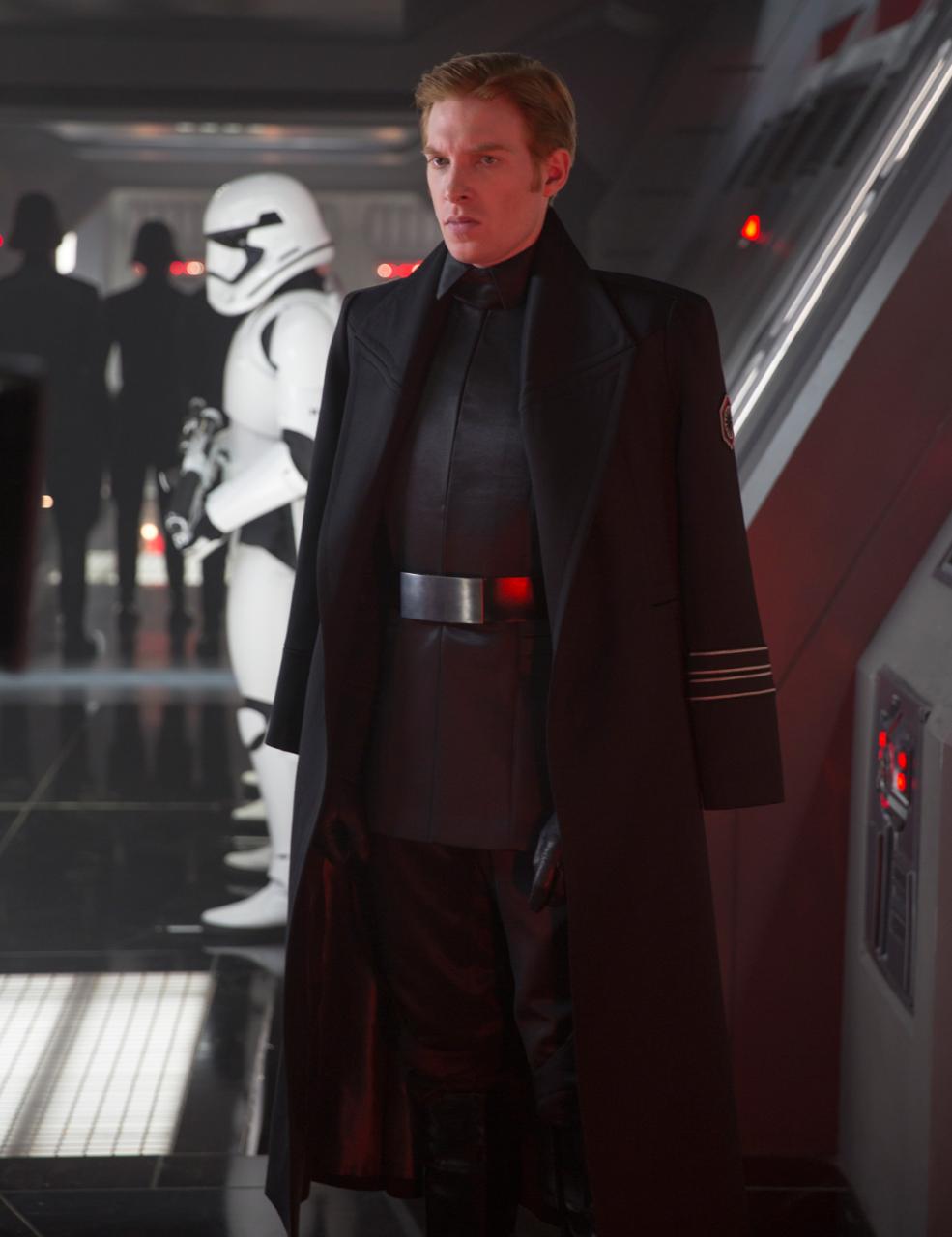
Why do the good guys never get the cool gear?
This leaves General Hux, probably the most interesting character of the First Order leadership aside from Ren. Hux's cut-glass English accent sets him in the ranks of just about all of the Imperial leadership and other high-ranking characters (Apparently this accent is 'High Coruscanti', in-universe), but he appears younger and possibly less experienced than most of his peers and immediate underlings, as well as a little timid - in some of his conflicts with Ren's against-the-book methods, he looks almost on the verge of tears (or perhaps I just have this association since seeing Gleeson blinking away at his painful-looking contacts in Dredd) - and he gives the first impression of a character promoted above their ability due to having the right connections or being very good at the theory side of things. However, Hux is clearly a zealot through and through, giving a blistering and bile-filled speech in front of his massed legions about the imminent downfall of the Republic, which is more than a little reminiscent of The Triumph of the Will, and ultimately he emerges as a competent, intelligent officer like Piett or Veers before him. An interesting little game the viewer can play is seeing how many British "Oh! It's them, from that thing!" actors crop up as Hux's junior officers throughout. The First Order ranks are filled out with the classic array of armoured Stormtroopers and TIE pilots - both groups having undergone serious upgrades in competence - and, in one striking instance, anti-lightsaber combat - since we last saw them, although that supposed 'armour' still seems totally incapable of protecting its wearer from even the most glancing of blows.

"They came from behind!"
"Pull out Wedge, you're not doing any good back there!"
J.J. Abrams' direction is tremendously stylish here, and very-well suited to the Star Wars universe. There are the traditional wide, still shots of sandy vistas that form our introduction to Rey and her home environment of Jakku, and the slow pans as we touch down to our first sight of a new world. But there's a liveliness and a creativity to his composition as well, as the camera is unafraid of darting in and out of scenery and characters, or whipping about so fast we can hardly tell where we are before bringing us up short with a sudden realisation - scenes such as Han Solo's entrance to old ally Maz Kanata's castle, or Rey's pursuit of Finn through a Jakku marketplace are excellent examples of Abrams' ability to move the camera far and fast while never allowing the audience to lose track of where everything is. Especially in action scenes, our viewpoint is constantly on the move, composing shots that are dynamic, colourful and angled (witness the Millennium Falcon's upside-down loop in the TIE Fighter chase above Jakku, or the camera darting in and out between the trees in Rey and Finn's duel with Kylo Ren in a snowy forest) without ever feeling overly 'arty'. Battles both in the air and on land are quick and chaotic, but Abrams knows the virtue - as many films nowadays do not - of maintaining a degree of distance and steadiness so that the entire scene isn't lost in spasmodic jittering while also keeping a degree of kineticism in the camera's movement, and there is an especially wonderful 'oner' as Finn watches Poe Dameron tearing through the skies in his X-Wing, demonstrating his ace pilot skills by alternating between taking down TIEs and the First Order's ground troops that just makes you want to punch the air and whoop. Granted, camera techniques and filming technology have improved greatly since the originals and probably quite a bit since even the prequels, but Abrams' direction feels so much more human and immediate than the more workmanlike efforts of Lucas, which always seemed far more interested in the cities and vistas of Star Wars than the people living in them.

One area in which the prequels can be said to have improved over the originals is in the music (not that the music in the originals was anything less than brilliant - except for 'Jedi Rocks'), and despite the awkward angstiness of the character's journey to that point, I will fight absolutely anyone who says that John Williams' 'Battle of the Heroes' isn't the perfect accompaniment to the tragic conflict between friends, with the fate of the galaxy hanging in the background, that is Obi-Wan and Anakin's duel on Mustafar. Having brought us an embarrassment of incredible compositions, powerful and so distinctive that you can vividly recall the scene they were used in just by hearing them, I must admit I was a little disappointed by John Williams' contributions to The Force Awakens. The music isn't bad, of course not - that would be impossible. But if you play the 'Imperial March', just about everyone will recognise it instantly, and much the same with 'Duel of the Fates', and many of his other tracks for both original and prequel trilogies. The quieter, subtler pieces like Rey's theme and its variations make great listening, especially the sections used at the beginning and end of the film (Funnily enough, Rey begins the film sliding downhill after taking something valuable from where it belongs, and ends the film trudging uphill to return something valuable to its owner), but there's nothing here to match the kind of instantly-placeable orchestral bombast as in Williams' previous 'Battle of Yavin', 'Battle of Hoth' or all three parts of the 'Battle of Endor'. There are some powerful and emotional cues in the soundtrack, but most of them are variations upon the already well-established 'Force Theme' first used when Luke gazed upon Tatooine's binary sunset, and they often lend an appropriate weight of history to quieter moments discussing the Jedi or links to the original films. However, It would be remiss of me, after nitpicking on the music so much, not to mention that one particular arrangement of this theme - the one used when Luke discovers his smouldering home and family in A New Hope - is redeployed here in a small, quiet but unquestionably epic moment, when Rey finally takes hold of the destiny she previously rejected, and undoubtedly contributes at least half the work in making this my single favourite scene in the whole film.


Clearly keen to return to the dynamic of the Original Trilogy, the filmmakers' use of a small band of plucky, rag-tag rebels battling clandestinely against an overwhelming fascistic power does the film a power of good in escaping from under the weight of the political tedium that suffocated the prequels, but we're never really told why the Republic is so unwilling to show their hand in the fight against the First Order. Consequently, a moment partway through the film when the First Order demonstrate their power and make Republic reinforcements almost impossible is robbed of some of the stakes-raising impact it should have had. I have no doubt that the information telling us how the galaxy got like this is out there somewhere, but really there should have been at least some of it in here, and an opening crawl that tells us more-or-less exclusively about the missing Luke Skywalker probably could have been more gainfully employed with this kind of spadework.

But it's not just the dynamic of the Original Trilogy that is resurrected: The Force Awakens shares many (perhaps far too many) story beats with the original films, especially A New Hope. A droid, carrying some data that the forces of evil seek to reacquire, becomes marooned on a desert planet. It meets up with a young and idealistic scavenger, who then joins up with a more worldly, unprincipled wild card out to have his own neck, and a crusty mentor who imparts some forgotten wisdom from a happier, more enlightened age. Together, they seek to return the data to Leia and her brave but ragtag band of misfits, and ultimately must exploit the weak point and destroy the enormous planet-killing superweapon used by the First Order. En route, they encounter a tiny and wizened alien who tries to instruct the main character about the nature of the force, a dark masked and cloaked lightsaber-wielding Force-user who receives instructions from a shadowy hologram of his master, and their journey takes them predominantly to a desert planet, a forest planet, and an ice planet. Obviously, when you phrase it like this you make it sound identical, but the similarities are there and they are undeniable. However, there's nothing new under the twin suns: the key is in the presentation, and on this count The Force Awakens feels so fresh and exciting - and so gloriously Star Wars - that it's entirely forgivable. 


It's broken all the records, won all the plaudits, and revived the Star Wars franchise like all the windows have been thrown open at once in a dusty old house. In that respect, The Force Awakens is the film we wanted, recapturing the simplicity and the sense of adventure in a realistically lived-in space opera setting, set out on the frontier with seedy spaceports, roguish smugglers, wholesome heroes and frightening villains. Gone are the overblown CGI-extravaganzas of the prequels, where technical tricks were used to obscure or distract from the failings of the story and the characters, or paint in every background and every other character. Location work and practical effects are back in and the CGI, though it still has a very large part to play, is used as a varnish to improve an already-solid film, rather than a crutch to hold up an inferior one. The flashy and acrobatic lightsaber combat of the prequels is out, and the functional, dangerous clashes of the originals are back in, with duels finally feeling again like fights between opponents intending to harm each other rather than choreographed dance-offs - battles with emotional significance to them that serve the story rather than stopping it dead. As we all seem to have been saying would be the case since the prequels were released, Star Wars has succeeded by stepping backwards and returning to its roots, but the most valid complaint to make against The Force Awakens is that while this approach with the tone and style was the right direction, taking the same tack with the plot stunts some of the fresh growth the series could have made. The onus will definitely be placed all the more heavily on the next films in the series to break new ground, but Episode VII had to resurrect a franchise that, cinematically at least, hadn't done anything for ten years (and anything really good for 32), and in that respects it comes across as a celebration of everything it was about Star Wars that captivated us all a long time ago, in a galaxy far, far away.


9/10 - Great shot kid, that was one in a million.

Thursday, 3 December 2015

Game - Call of Duty: Ghosts (Xbox One)

Duty called, but I pretended I was out.


"What's the difference between a Taliban training camp and an Afghanistani primary school?"
"I don't know, I just fly the drone."

This is the video game version of that joke.

Odin wasn't known for his lightning-hurling proclivities but FF: The
Spirits Within had already taken Zeus. Twelve years ago.
In a series which, of late, could be accurately renamed Morally Questionable Drone Strikes, Infinity Ward, Raven, Neversoft and whatever other deranged mish-mash of former Activision employees is making Call of Duty this week have produced the ultimate long-range power fantasy. Set twenty minutes into the future, the Middle East has been destroyed (What? All of it?) by some sort of nuclear accident, and the oil-producing nations of South America have banded together to form a Federation - and, naturally, because they're an empire-building global superpower that isn't the US of A, they're immediately and inexplicably evil and begin invading and conquering other countries for their natural resources: I don't know if this is a breathtaking lack of self-awareness or a confused attempt at satire. But protagonist Logan and his brother and father running around the shifting and crumbling San Diego as it's destroyed by orbital bombardment at least looks very impressive, and is a nice showcase of the sort of destruction that the next generation of CoD can bring us. It's just the whole "making it all actually mean something" bit that Ghosts fruitlessly bashes its head against like a sparrow on a well-cleaned window.

To kick off the story, America has constructed the space-based superweapon from G.I. Joe: Retaliation that drops tungsten rods and can obliterate whole cities from complete safety at the press of a button. The implications of America building and having sole control of such a weapon are - I should hope - deeply unsettling, but don't worry: it's only a deterrent, and a necessary tool of freedom-preservation. However, when it's hijacked by the Federation in a genuinely-impressive space-based prologue segment that blends Gravity and Moonraker - which is sadly only used once more in the story - it suddenly becomes a dangerous totalitarian tool of sudden and unavoidable oppression that cannot be allowed to exist. This sudden and bizarre determination to paint America as the poor shy little victim who keeps getting wedgied and having its lunch money stolen by the big nasty world would be hilarious if it weren't played so wrong-headedly straight.

The titular Ghosts: the first video game franchise to be birthed
from what some guy in another game wore on his head.
US military grunt Logan Walker and his brother Hesh (what sort of name is that?), two brothers stamped out from the 'Generic White Guy Protagonist' machine, begin the game under the command of their father Elias, fighting the Federation alongside the rest of the rank-and-file, but soon find themselves inducted into the secretive, legendary 'Ghosts' unit - of which their father used to be a member - in order to bring the fight to the Federation and their mysterious military commander Rorke: a former Ghost. Personally, the problem with this kind of plot in a 'gritty' and 'realistic' (snigger) shooter is that there are no supermen. Give them the daftest codenames and the ponciest balaclavas you want, the Ghosts are still just guys, and calling you elite when you play them feels as ridiculous as it is. Logan doesn't run any faster or jump any higher or shoot any better when he's a Ghost than he does when he's a grunt, because all that's determined by the player, so what the hell's the point in trying to pretend that being a Ghost makes a blind blithering bit of difference to anything? The Ghosts don't have any more impressive technology or ruthless methods or special skills than the SAS or the Rangers or even the FSB from the other games. So what's the point of them?

After the orbital devastation, San Diego is looking a little ruff.
For a good while, Call of Duty was very good at avoiding the "America! EFF YEAH!" school of whizz-bang shooty-fun. The boots on the ground in Modern Warfare were very oo-rah and aggressively patriotic but generally seemed to have their hearts in the right place and it wasn't really their fault that their headlong charge into danger resulted in dramatic nuclear annihilation for them, a city and, shockingly at the time but setting a rather predictable trend for the series, the player character. Ultimately, it was left to the quiet and elite throat-slitters of the British SAS to quietly clean up the mess, but it wasn't "Britain! BLOODY HELL YES!" either because they were just a tad sociopathic about the whole thing.

Here, it's essentially America Vs Those Dirty Underhanded Brown People, except the enemy leader is of course former-Ghost Rorke, because even a french-fries-and-freedom hating coalition of foreign superpowers need whitey's help to win their wars for them. Rorke has all the hallmarks of a very effective villain: he's always several steps ahead of the heroes; he has a seemingly endless arsenal and army; he has a doomdsay weapon and a suitably villainous mode of transport; he's always doing cool, villainy things, and - in grand Call of Duty interactive cutscene tradition - tanks the most absurd injuries and keeps going.

This screenshot is so totally dull I can't even think of a decent
caption for it.
The thing is, Rorke is just too good. He's not too good in the way that Batman or Superman are just too good, but in the way that Resident Evil's Alice is just too good. His strength, resourcefulness and constant victories come not from genuinely effective villainy or important story stakes-raising, but from the simple fact that the writers unaccountably fell in love with their bland creation and refused to allow him ever to lose - like a child in the playground who keeps bringing out his 'everything-proof shield'. He feels like a Frankenstein's monster of the successful bits of other villains, at one point shamelessly ripping-off wholesale Bane's jaw-dropping plane hijacking from The Dark Knight Rises, with the added ridiculousness that player character Logan is still inside the hijacked plane when Rorke detaches the cables and drops it God-knows-how-many feet to the ground, and somehow survives.

Ghosts is at its best in the space and scuba sections that give
you a whole extra dimension of movement to consider when
picking your fights. Pity that's about fifteen minutes in a six
hour campaign.
Do you remember the sequence in Modern Warfare 2 when Soap, alongside Captain Price, stalks through a snowy alpine forest with a silenced sniper rifle, picking off patrols and guard dogs while avoiding detection? And do you remember the even better version of that in one of the Spec Ops missions that asked you to do the whole thing without Price's voice in your ear telling you who to shoot, and when, and when it was safe to move? Well, the ludicrous plane-drop leads into a wonderful sequence where, cut off and wounded, you have to proceed through a lush jungle to reconnect with your squad while avoiding Federation patrols who outnumber and outgun you in every conceivable way. You have a suspiciously Alien-like motion tracker to help spot incoming soldiers, but the making of the level is the cramped and brilliantly-lit jungle, in which you can practically taste the pulpy, orchid heat rolling over you out of your screen, and which is designed less like a level and more like, well, an actual jungle, with no linear paths and no landmarks or obvious bits of lighting and signposting to point you in the right way. So you creep forward slowly, stopping and looking around desperately whenever a little red dot blips on your tracker or a shrub rustles a few feet away, making your way painstakingly towards the green blob vaguely in the direction of your objective. It's a masterfully tense sequence - one of a sadly meagre few in the game - that offers something a little different from the typical run-and-gun of most levels.

Someone clearly got a bit confused when ordered to wear his
shell-suit in the combat zone.
As for the gameplay, well, what did you expect? It's Call of Duty. The shooting is, as ever, lightning-quick and the guns feel satisfyingly punchy and weighty bits of kit. You advance through the levels, pressing the left trigger to look down the sights at the seemingly-endless assortment of brown people the game spawns for you and pressing the right trigger to make them fall over until there aren't any more coming, with the now de rigeur breathing spaces where you crouch behind a stack of boxes and fiddle with a PDA to remotely snipe/bomb/dog-attack, which turn up just frequently enough to be predictable but just infrequently enough to be more of a gimmick than a bona fide game mechanic. There's a tank mission, and a slightly disjointed-feeling helicopter assault, a scuba bit with insta-kill sharks, an abseiling-down-the-side-of-a-building-while-shooting-through-the-windows bit that lets you catch a falling photocopier with your face, and one shining but brief moment in the penultimate mission where you go into space again, and then back down to terra firma for an ending containing the requisite number of vehicle crashes, cutscene injuries, scenes of stumbling blurrily around with blood on the screen, alternating LT and RT to crawl towards something and Pressing X to Not Die.

And then, to cap it all off, writer's pet Rorke emerges from the same submerged trainwreck you did, having spent several more minutes under than you did during your near-drowning experience but apparently none the worse for wear from that or the .44 slug you put in him, and abducts your helpless form to render the ending more or less utterly futile and make way for a sequel that a story this predictable, frustrating and, frankly, disconcertingly racist probably isn't ever going to get. Or at least shouldn't, if there's any justice in the world.


The evolution of the Call of Duty series can be marked out by the
sheer volume of superfluous bric-a-brac it's possible to have stuck
to your guns increasing with every instalment.
The first Call of Duty for a new console generation, Ghosts had the opportunity to truly do something new to the franchise, especially after the bloated extravagance of MW3 couldn't really think of anything to bring to the table other than far too much more of what MW2 had. At the very least it could have tried to think of something new to say about war. Instead, the usual flag-and-bald-eagle-waving, it's-not-evil-if-it's-us-doing-it patriotism nonsense gets trotted out in service of a short but meandering, surprisingly uneventful and certainly uninvolving storyline, with a pointless protagonist and his cardboard brother, and a villain who lacks even a tenth of the personality of a Shepherd or a Makarov but unaccountably has ten times the survivability so we'll probably have to deal with the dull git again at some point.


5.5/10 - Instead of resurrecting the franchise, the appropriately-subtitled Ghosts just lingers past its welcome and rattles the old chains some more.

Sunday, 1 November 2015

Film - Hear My Song (1991)

The man that makes the blarney.


Hear My Song is a gentle, whimsical Irish musical comedy co-written and directed by Peter Chelsom (Hannah Montana the Movie, but don't let that put you off) - very, very, very loosely based on a true story. It concerns a failing huckster of a Liverpool music hall impresario, Micky O'Neill, whose already-on-the-rocks establishment - in which his best act is impersonator Franc Cinatra, whose only resemblance to Old Blue Eyes is his hat - comes under threat of closure at just the same instance as his relationship with his girlfriend Nancy takes a sharp nosedive into "it's complicated", while her mother looks at him like a slimy con-artist who doesn't deserve to lick Nancy's boots. His solution to both these problems? Find Josef Locke, famed Irish tenor who fled the English taxman back to his native shores (there, that's the first true part of the film) - leaving behind "a beauty queen, a Jaguar sportscar, and a pedigree dalmation, all of them pining" - and bring him back for a command performance. Except the man Micky books as "Mr X" isn't Josef Locke (and a mysterious man called Mr X who many believed to be Josef Locke is the second and final true part. Told you it was 'loosely'.). Micky is fooled by the impostor but Nancy's mother, the beauty queen (Shirley Anne Field, The Pink Panther Strikes Again) left behind by Locke, isn't, and Micky's relationship and business are ruined. The only thing for it? Travel to Ireland, meet up with an old friend, and go on an endearingly quirky rural journey to find the real Josef Locke.

'Smoking in a pub' makes Hear My Song an Unintentional
Period Piece.
Leading the talented cast is co-writer Adrian Dunbar (Ashes to Ashes, The Crying Game) who plays Micky with an affable oily roguishness - like an Irish Han Solo, but with fewer lasers and more lying. From an actor who seems to have largely - before this role and since - played sleazy, cold-hearted criminals, it's a surprisingly amiable performance that keeps the audience on his side even as they wince at his spiralling lies and tut at his contemptibly obsequious wheeler-dealing, and the script happily piles on slice after slice of humble pie for him to eat - or be force-fed - until he's finally been knocked low enough (and then down a few more rungs for good measure) to be worthy of his vivacious girlfriend and his own business. His  misadventures with compatriot Fintan O'Donnell as they meet with unhelpfulness and suspicion from the rural Irishmen they ask for information about Locke, and then are given the runaround by Locke himself and his cronies, result in more than their fair share of humiliation and comic injuries, including but not limited to bar fights, alarmingly unsafe impromptu dentistry, near-blinding, and almost being thrown off a cliff. Throughout these scenes, Dunbar demonstrates a finely-judged willingness to look ridiculous and be humiliated in the role without ever sending it up. Dunbar allows the true nuance of the performance to shine through in his scenes with Locke and later with Nancy, as Micky realises that humility and sincerity can be more persuasive than the silverest of tongues.

"If Locke doesn't want to listen to my offer, perhaps I'll have
to leave this enormous cow's head in his bed."
Joining him as Fintan is stalwart Northern Irish actor James Nesbitt (Murphy's Law, The Hobbit), who only misses out on being the incompetent comic relief to Dunbar's straight man by dint of the pair of them actually being near-matched in buffoonery, though Fintan is less devious and slippery than Micky and consequently comes in for significantly less abuse. The pair abound with Irish wit and one-liners as they wheedle, coax, charm and beg their way past unhelpful Irish locals to the even more unwelcoming tax-exiled tenor himself. Micky wryly implores Locke to think of the effect his return would have on his female admirers, assuring him that "there won't be a dry seat in the house". In another instance, he admonishes Fintan that he is "drivin' like a madman". "You think this is bad?" his friend replies, "You should see me when I'm on me own!". Micky's reply is to remark that "sure I'd hate to be with you when you're on your own". Despite such dry deadpanning, they also demonstrate an affinity for slapstick in a scene in which, surely inspired by the old joke about the men who find an enormous hole in the ground while out walking in the woods, they throw a log down an ineffably deep well, and then fall over themselves trying to stop the cow tied to the other end of a very long rope following it down.

"Is that a bird or a plane, Mr Luthor?!"
"Wrong film, Ned."
Appearing as the main man himself is American actor Ned Beatty (Superman the Movie, Deliverance, Silver Streak), who I presume was chosen for his visual resemblance to Locke - though his Irish accent is perfectly serviceable as well, even if he doesn't actually do the singing parts himself. Generally unseen until the final third of the movie, Beatty damn-near steals the film away from the leads as the tax-exiled and reclusive Locke, whose large profile and initial menace upon his discovery make him resemble nothing so much as an unwisely-awoken bear. Locke is technically a criminal by English law, and so his introduction is swiftly followed by his threat to drop the investigative duo from a cliff, but Beatty plays the role with a twinkle in his eye and it's hard to say what's threat and what's showmanship. He swiftly warms to Micky and Fintan after (what else?) having a drink with the pair, and he agrees to come back to England with Micky for one last sell-out performance to revive his failing club. There's a very nice scene where he reflects with Micky on the difficulty of living up to the legendary image that has grown up around him. Spotting some young women of the kind who used to scream for him at the music halls, he asks "Do you see those girls, Micky? Would you like to be responsible for their dreams?". It's a sobering scene, as Locke reflects on the danger in a comeback that might expose his failings now that his old fans' rose-tinted glasses have worn out, but it's appropriate that the faded romantic Locke is ultimately the one who pushes Micky into realising the importance of winning back Nancy. The singing itself, dubbed by Vernon Midgely, is utterly fantastic, and while Irish tenors may be something of a niche product to sell to today's music buyers, the songs chosen to represent Locke's oeuvre here are pleasant and melodic but also rich and powerful. William "Porkins" Hootkins (Star Wars: A New Hope) has a small, amusing role as the comically theatrical show-off Mr X, and David McCallum (NCIS, The Man From U.N.C.L.E.) crops up throughout as the detective who's made it his life's work to track down the elusive Locke, and has started to lose his grip on sanity for his troubles.
 
Nancy had always found Micky's large ears his most 
fascinating feature.
Fresh from drama school in the small but key role of Micky's dentist girlfriend Nancy is the sparkling Tara Fitzgerald (Brassed Off, Sirens), who probably achieved the fastest typecasting of any actress in history when she leapt out of bed, very naked, just minutes into the film when an incensed Nancy storms out of the bedroom after Micky fails to adequately convince her of his devotion. It's a genuinely funny scene, and Fitzgerald impresses with both her bravery and her comically furious delivery - hysterically shrieking "vice versa!?", Micky's feeble rejoinder to her mid-coital cries of "I love you!", as she pulls her dress on and runs off into the night - but a cynic might say (and he will) that it's hard to shake the feeling that Fitzgerald is being used as a "thank you for watching" present for the audience. I'm sufficiently well-adjusted that I don't feel the need to sign myself 'Disgusted of Tunbridge Wells' whenever a thespian tackles a scene in the nude - one could hardly appreciate Fitzgerald's body of work if it were otherwise - but there's a time and a place and it just doesn't sit quite right in this quirky and whimsical oddball of a film. But, in the interest of balance, I can't say the film really serves the character all that badly either. Nancy is an unusually strong rom-com love interest, and Fitzgerald's performance, full of gamine charm, is at its most nuanced in her early scenes, compassionately but firmly holding Micky at arm's length for the eventual good of the relationship. It's a shame that neither Nancy nor mother Kathleen really appear much outside of the first and final acts, as the film is sorely lacking any kind of feminine influence for the majority of its runtime, but Fitzgerald makes more of her role than its brevity asks of her, especially with some charming facial expressions in her wordless first scene where she reacts to Micky's serenade at his club, and a scene near the end where Nancy puts her own spin on one of Micky's classic spiels and out-shysters him. Her stand-out moment, perhaps predictably, is the reconciliation in Nancy's office: we can see that her impulse is to forgive and forget but she must, sensibly and cautiously, reassure herself that Micky truly is changed first. These scenes can often be overplayed and melodramatic, but director and actors resist the temptation to wring cheap tears and fuzzies from it, and the scene is all the more real and affecting for it.

This film might hold some kind of record for 'number of times
a crowd is addressed through a microphone'.
It's quite a clever move by writers Chelsom and Dunbar to tie together Micky's personal and professional goals in his single 'quest', as Micky's attempts to win back his nightclub, given that he doesn't seem to deserve it, probably wouldn't have been sympathetic enough by themselves. In many ways, this film is your standard rom-com plot, in that boy gets girl, boy loses girl, boy makes amends and learns some lessons, boy gets girl back again. Far too many films make the basis of the break-up some trivial and unlikely misunderstanding, which has the side effect of making the man look dense for failing to just spit it out and the woman look paranoid and vindictive for jumping to conclusions and refusing to listen, in what the writers surely must realise is a tremendous disservice to both genders - not to mention a very poor indicator that the relationship itself will last any longer than the ending credits. It's a disappointing but predictable trap to fall into: if the relationship is to survive, the cause of the temporary rift naturally cannot be a real deal-breaker. The cleverness of Hear My Song is not that it subverts the gender roles of the offender and the offendee, but that it alters the dynamics of the relationship instead. Nancy's mother Colleen was a risk-taking beauty queen who probably had her share of ill-advised beaus (Josef Locke, for one), and Nancy herself has clearly carried on in the same vein, taking a bit of a punt on Micky in the hope that the slippery exterior hides a heart of gold - sadly, she is being all too reasonable when she concludes that it does not. The break-up between the sheets feels like just the latest in a long line of minor but cumulative hints that Micky just isn't as invested in this relationship as she is. Yes, Micky is unworthy, approaching both his club and his girlfriend with the same strings of evasions and broken promises, and does need a few life lessons courtesy of his adventure to reevaluate his priorities. It's only when he's trying to convince Locke to return that he realises that getting his club back is only a secondary consideration to repairing his relationship with Nancy. Although Micky undergoes the customary herculean tasks and abject humiliation, Nancy neither sees nor demands them, and their final reconciliation comes about not through overblown romanticism as we might expect, but simple humility and compromise. You know, like it does with real people and not movie caricatures.

No witty comments here. Just... wow. What a gorgeous shot.
Director Peter Chelsom clearly has an eye for visual flair, composing some striking and often amusing shots - there's a particularly nice revolving shot around Mr X as he plays up his sense of mystery by fluttering a magically-produced dove around his hand, and the coven of lady owners of Micky's club all crammed onto one couch has to be seen to be believed. The Irish countryside is photographed beautifully although, to be even-handed about it, it would perhaps be more remarkable if they hadn't made it look spectacular, given what they had to work with. But Hear My Song truly comes alive at the night scenes, the dull grey washout of day replaced with the stark blues and blacks of night and the burning golds of candlelight and chandeliers. The film ends in a sort of low-key version of The Blues Brothers: no car wrecks, but with a final belter of a performance surrounded by police, as McCallum's unhinged detective smashes a crane into the club in desperation to stop Locke's show.

In terms of tone and style, although it is slightly more musical, Hear My Song owes a substantial debt to Bill Forsyth's fantastic 1983 film Local Hero, in which an American oil company rep ends up falling in love with the rustic and eccentric Scottish coastal town he was supposed to be persuading to sell up. Although happy to throw their heroes into bizarre and sometimes humiliating situations, and though they maintain a somewhat whimsical state of heightened reality, both films develop their characters with a fondness and attention that raises the plot above the sitcom level of city slicker vs crafty yokels, and with a perfectly small-scale focus that ensures their happy endings feel earned rather than given. For all that, Hear My Song is not perfect: the lures of some gentle comedy, clever dialogue, snappy music, amusing (for once in a blue moon) relationship drama and even a naked Tara Fitzgerald aren't quite enough to grab you into a meandering first act that's essentially the film lacing its shoes up for thirty minutes; the offbeat, almost-surreal musical humour (Micky's two large helpers spontaneously bursting into dance on the street and being mistaken for buskers, for example) is infrequent enough that it can come across a little forced when it does crop up; and the final ending scene might be a little stagey and saccharine for some, if indeed the whole film isn't. However, it's my review, and Hear My Song has fine acting, witty banter, humorous situations, colourful characters, Irish stereotypes, brilliant music, and a quirkily original story. Go watch it.


8/10 - Worth at least a tenor

Friday, 30 October 2015

Meet the new blog, same as the old blog

Hello and welcome to the new locale!

Pull up a post and take in the view.

Game - Transformers: Rise of the Dark Spark (Xbox One)

Transformers: Lack of Distinction


High Moon Studio's War for Cybertron and Fall of Cybertron did for the Transformers video game franchise what Arkham Asylum and Arkham City did for Batman's, albeit not quite in such a commercially or critically acclaimed way: a compact, focussed first game telling a new story in a colourful, familiar universe, and a second, looser but deeper second game expanding on the same story and, come the end, setting up an interesting new direction for the series. Larger-than-life portrayals of well-known characters abound, garnished with fan-pleasing references and faithfully overwrought dialogue (it's a wonder there's any of Cybertron left with Megatron and Optimus chowing down on every bit of scenery in sight) to prop up a brand new story.

Shiny Age of Extinction Optimus lacks a little of the boxy
retro charm of Cybertron Optimus.
Now, to tie in with Michael Bay's Age of Extinction, the series falls into the hands of Edge of Reality (Because High Moon are working on the real sequel? Please?), that bridges the gap between both War for Cybertron and Fall of Cybertron, and the 'classic' Transformers of the game and the jagged, metallic Transformers of the Bay films, positing an ancient and powerful artifact - the Dark Spark - fought over by Autobots and Decepticons on Cybertron, before falling through time and cropping up centuries later when the 'Bots and the 'Cons have relocated their fight to Earth. As a story, it fits fairly neatly between War and Fall - a few continuity errors around the Insecticons and Megatron's rebuilt body notwithstanding - but doesn't really follow on from War or particularly lead into Fall. The war rages, the Dark Spark turns up, the Dark Spark is dealt with, the war rages on. Rise of the Dark Spark, then, is the Arkham Origins of the series: a shallower, less polished prequel no-one asked for, whose main successes come from re-using the tried and tested tools of its more adept predecessors. But this comparison is a little unfair... on Arkham Origins, which at least managed to be wholly technically competent, even if its initial promise is hastily bundled aside to make room for more fanservice cameos, and it tries to get by mostly by trading on the goodwill earned by previous instalments and reusing their party tricks... wait, which game am I talking about here?

Dark Spark is not sunk by its technical issues, but it certainly springs a few leaks it could do without. Loading screens between missions are longer than those in any new-gen game this small have a right to be, and even though there are multiple opportunities to disguise the level loading with the arduous walk-and-talk sections that slow down the pace of the mission to something akin to a gaggle of elderly women walking abreast down a narrow corridor so you can't get past them, there are still plenty of times when entering a new area will briefly freeze the game as it loads in. If this weren't grating enough, the programmer who placed his miserly allotment of checkpoints before every unskippable cutscene he could find needs to be suspended by his knackers from the roof of Activision headquarters, and be constantly told he'll be released in just a few minutes. The environments in the movieverse Earth scenes are generally drab, mid X360 era-looking graphics, with less detailed, more plasticky character models to match (Finding it a bit difficult to make a good-looking game when you can't reuse High Moon's assets, eh?), and with virtually no variation from the mission structure of running down a corridor shooting enemy robots, then running out of the corridors into a large open arena and shooting enemy robots, then back into corridors again, like a succession of small cardboard boxes tied together with string.

Jazz and Optimus sneak into Kolkular with the stealth and
subtlety all Transformers are known for.
Still on the technical side, and there are some improvements. Particle effects, at least, are significantly flashier and prettier, with the explosion and fire effects, particularly (heh) those associated with Grimlock's flame breath, looking impressively pyrotechnic. Most character models are also very pretty and look at least a little shinier than they did in Fall, although there was also a strange graphics bug throughout the game that caused reflective, metallic or luminescent surfaces - guns, walls, crates and, oh, say, Optimus Prime's entire back - to become speckled and translucent, especially when in motion. Though present throughout, it appeared most pronounced in areas of purple light - wouldn't have been a problem for the chromatically varied Fall of Cybertron, but you visit a lot of Decepticon bases in Dark Spark and the 'Cons really love them some purple.

Combat is a mixed bag. Melee combat feels clumsy and underwhelming, when both lightweights like Bumblebee and enormous bruisers like Optimus Prime use the same striking animation and deal the same amount of damage, and characters' swinging arms tend to only bear a tenuous relationship to the actual effective area of their strikes. For ranged battle, by contrast, the guns all have a pleasing weight and heft to them, and their upgrade trees feel well thought-out enough that a fully-upgraded weapon is substantially stronger than its vanilla counterpart without being game-breakingly overpowered... (except for the Riot Cannon which is, as the achievement for getting 100 kills with it tells you, 'Totally OP') but then, the guns and the upgrades would feel this way, because they're exactly the same as they were in Fall of Cybertron. Exactly. The. Same. Edge of Reality hasn't even felt compelled to add a single new weapon, and this is especially painful in the uninspiring Earth sections which are in sore need of some spark of originality about them... plus, I can't believe that neither side has tried inventing a new weapon in the millennia between the two settings.

Optimus' favourite weapon, the Path Blaster, is a devastating
hand cannon that blasts Decepticreeps into scrap.
Another missed opportunity in combat comes from the total lack of any situations or set-pieces requiring you to change tactics. There's nothing like Fall's defence of Iacon with the aid of Metroplex's artillery cannons, or the Decepticons' wheeled and then airborne assault on the Autobots' energon carrier. The variety in Transformers you play is much less than previous games, with only three or four missions as Decepticons - Soundwave, Shockwave, Swindle - and most of the Autobots missions casting you as Optimus Prime, Cliffjumper or Bumblebee. Unforgivably for a Transformers game with the power of new generation consoles behind it, enemy robots do not transform, and if the enemy aren't changing their tactics or their forms, there's no real inducement for you to, either. Unlike its predecessors, Dark Spark's levels rarely give you much need to change to vehicle form. Shockwave and Jetfire's levels are large, spacious and frequently devoid of floor often enough to make flying a necessity, but land-based vehicle forms will see less use than a D&D player's bedsprings, except for one mission as Optimus which forces you to transform right at the start to drive down some tunnels towards Megatron's fortress... tunnels that will look rather familiar to anyone who played Fall of Cybertron. Hey, if they're going to reuse all these assets, I'm sure they won't begrudge me reusing this criticism. 


Grimlock's particle effects are very pretty indeed... the same
cannot be said for his poorly-textured, jagged model.
This is all the worse for the moments of genuine enjoyment and Transformer-ness that do occasionally crop up in spite of Edge of Reality's best efforts. During Jetfire's infiltration of the ruins of Trypticon, in which he comes across a secret band of Starscream's soldiers harvesting Energon, I used my jet mode's missiles to bring down the enemy air support before strafing the ground troops with rapid laser cannons, the rocket-firing soldiers falling and exploding under the hail of burning light. I then swooped low, screaming down out of the sky before transforming mid-dive, landing in the middle of the frazzled survivors and unleashing a special ability that blew them into slag, before taking up my handheld rapid-fire repeater and charging the entrenched enemy positions further along the landing platform. It was one of exceptionally few moments where I actually felt like a Transformer, and not just a colourfully armour-plated Marcus Fenix.


One very significant changes involve levelling and equipment. Instead of purchasing weapons and upgrades from Teletraan 1 terminals using mountains of your hard-earned energon shards, carefully weighing up cost and benefit and prioritising your favourite weapons, you now unlock Gear Boxes in Bronze, Silver, Gold and Prime when completing challenges, getting achievements or levelling up. They can gift you with any number of unlockables, including new weapons, weapon upgrades, online characters, TECH abilities, and special HACKs new to this game - essentially the game's version of Halo skulls, adding challenge or mutations to the campaign while increasing XP - but the fact that they're unlocked totally at random instead of deliberately purchased removes the sense of achievement from acquiring a powerful upgrade, and leaves you without the option to deliberately unlock or spec the weapons you like. To make matters worse, having to pause the game and open each box separately from the menu results in your gifts - many of which will by the later stages be duplicates that are converted into TECH abilities - flashing up one by one no matter how hard you stab A, and it's a teeth-gritting exercise in tedium.

In the final showdown, Optimus has a throw down with Lockdown
who gets knocked down and taken downtown.

Now, voice acting is where these games have always excelled, and here is no exception. Leading the cast are, of course, definitive Optimus Prime Peter Cullen and scenery-chewing Fred Tatasciore as Megatron, with the usual assortment of Nolan North, Troy Baker and Steve Blum thrown into the mix. Most of the Decepticons are growling, bellowing psychopaths, while the Autobots are pure, unfailingly heroic paragons, but the cast do a good job of differentiating between the characters and giving them each a distinct personality (something the Bay films could have learned a thing or two about), and the sniping, scolding and verbal backpedalling between Megatron, Shockwave and the wheedling, devious Starscream makes for some of the game's vocal highlights. The cast are working with a somewhat weaker script than on previous outings, with dialogue ranging from the flat to the overblown - even for ham-meisters Megatron and Optimus - and lacking much of the spark (heh) and humour of War and Fall, but the performers bring a lot of life and much-needed conviction to the otherwise fairly thin story. However, on the villain side for the movie portions, we have Lockdown, who differs so vastly - along with the rest of the Earth levels, to be honest - from his movie counterpart there scarcely seems any point in making it a tie-in at all. Not only is he not British (boo), but he acts significantly out of character as well. After acquiring the Dark Spark in the prologue, he instantly becomes a ranting megalomaniac - a Megatron-lite - obsessed with power, domination and destruction. Oh, the writers saw this for the flaw it is clearly enough to continue giving Lockdown lines expounding on his desire for profit and trying to justify his new appetite for destruction with the promise of future payment, but by a bot's actions shall ye judge him, and Lockdown exhibits none of the mercenary attitudes or professional detachment that managed the impressive feat of making a character in a Michael Bay film interesting.


Megatron, who already is a ranting megalomaniac, is not significantly altered by his acquisition of the Spark, which is in itself a problem. Megatron - here looking as spiky and shiny as he did in Fall, which is wrong because this is his post-rebuild look after being squashed by Metroplex at the beginning of that game - is supposed to be ascendant here, as the Decepticons come closer and closer to crushing the Autobots forever. Yet, within two or three disjointed missions of Megatron attaining the Dark Spark, Optimus Prime is infiltrating Kolkular, Megatron's fortress, with the intention of destroying the Spark and his old enemy at the same time. Naturally, permadeath being as welcome in this franchise as a Sex Pistols concert in St Peter's Basilica, this second objective isn't achieved, and Megatron scurries away with the usual serious but recoverable injuries to scheme another day. However, the Dark Spark fails to endow Megatron with the phenomenal cosmic power its awe-inspiring legend suggests it has, and after a fairly weedy boss fight with Megatron and some reanimated, brainwashed Transformer zombies created by the Spark, the universe-threatening MacGuffin is dispatched and summarily fired into space. Consequently, we have a plot which drags a lot in the earlier sections and then wraps everything up far too neatly and quickly towards the end, and unlike previous games there's never a sense of a wider war and higher stakes going on beyond the confines of the playable characters and their missions.

Soundwave's highly targeted form of pest control is a rare
moment of inefficiency for the logical, robotic Decepticon.
There are far too many occasions (i.e. more than one) when the game stalls you in a room and throws constantly respawning goons at you with all the predictability and ease of a pop-up shooting gallery, without any background dialogue to divert your attention, or even give any clues when the tedious onslaught might be trickling to a halt, perhaps the nadir of which is a tortuous segment as the enormous Combaticon-formed Bruticus outside the gates of Kaon, which mainly consists of waiting for your one-hit-kill AOE move to come off cooldown, using it on all enemies at one entrance, slowly lumbering over to the other entrance, and then waiting, rinsing and repeating until comatose/the level is completed, whichever comes first. Dark Spark is desperate, however, to remind you that it's a movie tie-in and the relevant sections are contractually obliged to be worse than any of the developers' original plot points on Cybertron, so the Earth-set endgame levels throw a few more respawning waves at you, with the added pleasure of Lockdown's terminally uninventive mercs taunting "Let's see what we've got" so often it probably amounts to psychological warfare.

Even thirty-foot robots drop contact lenses sometimes.
Playing as the hulking, tanky, damage-dealing damage-soak Grimlock briefly makes for a nice change of pace, as you sweep Lockdown's mercenaries aside with your mace in robot form or crumple them underfoot in your dinosaur form... exactly as it did in Fall of Cybertron. In that game, Grimlock's thunderingly powerful dinosaur form was a reward for building up enough rage to earn a limited amount of time to just go T-Rex and mess some 'Cons up. Unlike Fall of Cybertron, Grimlock's entrance here is an embarrassingly damp squib, as his dino-form crashes weakly through a gate to absolutely no soaring response from the background music, the gate bashing aside like a bendy bit of polystyrene and Grimlock unleashing a pitifully mewling roar - a textbook lesson in why not to make cutscenes in the game engine if ever there was one. Rubbing salt into the wound, he looks stunningly last-gen, and not late last-gen to boot, and his animation for transforming from dino to robot form is clunky; the moment when they simply swap from one character model to the other is painfully obvious. While it feels initially empowering to stomp mercs underfoot, it quickly becomes repetitive, and their lack of damage, combined with Grimlock's extreme resilience and execution move which restores him to full health and shields while making him invulnerable during the animation means that there's virtually no challenge in the level and a half we're given to play him in.

Drift forsakes his swords-only vow to dispatch his most hated
foe... a fuel barrel.
There's a fair amount this game does right, but it's very difficult to award points for it because Fall of Cybertron did it first, and RotDS often comes across as little more than a rushed expansion for the earlier game, hoping to earn a little more green by piggybacking on Michael Bay's latest overblown, under-brained CGI-fest, to the plot of which even the movieverse sections bear virtually no relationship to anyway other than the presence of Lockdown and the redesigned Optimus. The Cybertron-set sections of the game are fun but only serviceably so, bringing back the same - exactly the same - thrills and set-pieces of the previous games with some slightly shinier character models and better effects, though marred by a lack of spark (heh) in the dialogue and a story that somehow manages to be both paper thin and convoluted. The movie-verse segments, however, (i.e. the bits where Edge of Reality had to finally do some damn work of their own) take a noticeable dip in quality, with bland character models, blander and uglier environments, annoyingly limited enemy chatter, and weapons, gameplay and enemy models so utterly identical to those in Cybertron that you won't believe the two sections are supposed to be thousands of years apart.

Though the tried-and-tested formula of the previous games is alive and well enough to make this one of the better movie tie-in games out there, most of the good points Transformers: Rise of the Dark Spark can raise in its defence are there because Fall of Cybertron, especially, used them already. The result is a game that, by general standards, is patchy but serviceable and diverting enough for a time, but by the standards of its franchise is a disappointing entry, and one that is hopefully only a stopgap before High Moon is given back the reins of the franchise into which they managed to breathe so much more life than any other developer before... or since.


4/10 - No more than meets the eye